Please visit my new website at www.deannapayson.wordpress.com
Thank you!
Tuesday, January 22, 2013

Sunday, January 20, 2013
Homemade Sauce & Meatballs

You will need:
2 cans crushed tomatoes
 Italian seasoning (OR basil & oregano)
Garlic powder
Parmesan Cheese
Olive Oil
1 lb ground beef
2.5 cups Italian bread crumbs
2 eggs
1) In large pot, combine 2 cans of crushed tomatoes with 1 can of water. Coat the top with equal parts garlic powder and Italian seasoning. Set to a low boil, stirring occasionally.
2) Using your hands, blend ground beef, bread crumbs and eggs in a mixing bowl. Mold into meatballs!
3) In a microwaveable casserole dish, place meatballs into 1 inch of water. Cook in the microwave on high for 7 minutes.
4) Add meatballs to the sauce!
5) Continue to stir the sauce & meatballs occasionally on medium-low heat for 2 hours.
6) After 2 hours, add 1 cup of Parmesan cheese and 3 tablespoons of olive oil to the sauce. Stir.
7) Continue to cook the sauce for 1-2 hours, or until it has thickened. Add additional spices to taste.
8) Serve over pasta, and enjoy!
Variations:
- If you wish, you can boil your pasta IN the sauce! This gives the pasta more flavor. However, if you're making the sauce with the intention of freezing the leftovers, simply cook the pasta separately.
- Some people like to add a bit of sugar (about 1/3 cup) to their sauce. This makes it a bit sweeter, which isn't my taste, but if you enjoy this go right ahead!
Monday, January 14, 2013
New Year, New York!
The perfect way to kick off the new year, I embarked on a two-day trip to New York City with twenty-six of my graduate public relations peers. The whirlwind trip gave us helpful insight into the 'real-world' of public relations and the realities of post-graduate life...both the glory and the gore.
Thanks to our hosts at MBooth Public Relations, Edelman, Marina Maher Communications, Time Warner, Viacom and the talented alumni who spent their Thursday evening with us at the Lubin House!
Thanks to our hosts at MBooth Public Relations, Edelman, Marina Maher Communications, Time Warner, Viacom and the talented alumni who spent their Thursday evening with us at the Lubin House!
Wednesday, November 28, 2012
#LostInSocial: How is social media best managed?
#LostInSocial from Deanna Payson
We reached quite a few people on Twitter with the presentation!


We reached quite a few people on Twitter with the presentation!

To prepare, I used a variety of social media tools like G+ hangouts, Pearltrees, Twitter, Slideshare and LinkedIn groups.

Tuesday, November 20, 2012
PRL 614: Crisis Planning & Press Briefings
Last week in our public relations
writing course, we were assigned teams and simulated crisis press briefings to
implement for our classmates. One of the
teams was assigned to develop a crisis plan and execute a briefing for the Costa
Concordia crash last January. Their plan
included a comprehensive response outline, including responses for social media
and the company's website. Overall, I
was very impressed with their professionalism and key talking points for this
simulation!
"Isolated incident"
However, one suggestion for
improvement would be to avoid labeling this accident as an "isolated
incident." The faux CEOs of Costa
and Carnival both used this term occasionally in an attempt to reassure their
stakeholders that an accident of this nature would likely not repeat
itself. While I see the value of that
reassurance, I believe the wording of "isolated incident" has the
side effect of connoting minimization of the event's severity. That effect was obviously not their
intention, and the words "isolated incident" are used quite often in
crisis responses by organizations. However,
I would advise CEOs and spokespeople to avoid the use of that phrase.
I thought that the group's stress on
their cooperation with the Italian authorities lent a significant amount of
strength to their presentation. Also,
they kept a serious yet positive tone throughout the briefing, which conveyed
their wholehearted commitment to remedying the situation. For example, when the customer service
representative (played by Jen Zink) was talking about the reparations being
made to the passengers and families affected, she began by saying that
"what was lost can never truly be replaced." This validates the
emotions felt by the affected customers, showing that the company understands
and sympathizes with their plight.
Overall, the Costa/Carnival group's
press briefing was an effective communication of the company's commitment to
fixing the situation and taking responsibility for the events that
transpired. It is difficult, if not
impossible, for an organization to predict 100% of the possible crises that may
arise due to human error or technical failures.
However, if organizations respond as this group did in their simulation,
they will likely survive such a crisis.
Monday, November 12, 2012
Starbucks: The Business of the Future?
Last
Friday, Newhouse welcomed back many distinguished alumni for "PR
Day," a day of lectures and discussions aimed at providing current
students with valuable insights into their future careers. The morning session was led by Jim Olson,
Vice President of Global Corporate Communications for Starbucks. Equipped with twenty-one years of experience
in the field since graduating in 1991, he shared his, and Starbucks', vision of
what "21st Century Leadership" means.
The
lecture began with Olson explaining the transformation of Starbucks from a
company of "commoditization" to one based on values and experience
that began in 2007, with a memorandum from Howard Schultz to the corporate
leadership. In this memo, Schultz
stressed that in order to not fail as a corporation, they must get back to
"the core" of the company: the Starbucks experience. The tumultuous period following this memo
included a sharp dive in stock prices and store closings to re-train
employees. However, as Olson put it,
"it was an investment we had to make."
"Our mission: to inspire and nurture the human spirit – one person, one cup and one neighborhood at a time"-Starbucks' mission statement
In the
years since Starbucks' dramatic transformation, the corporate leadership,
particularly Howard Schultz (CEO), has led the company toward a unique business
strategy based on values, community and social responsibility. Rather than corporate social responsibility
(CSR) being a function only of the public relations or community relations
department, the values behind CSR drive all decision-making at the
organization. For example, in August
2011, as the United States seemed to be drowning under a weight of debt and
unemployment, Schultz saw himself in a unique position to make a change in the
communities in which Starbucks operates.
With Olson and the communications teams' help, Schultz and Starbucks
began inspiring CEOs to take a serious look at the state of federal politics
and to focus on job creation within their own organizations rather than petty
partisan arguments. Rather than being
reactive in their approach to CSR, and only implementing programs directly
linked to a tangible ROI for the company, Starbucks was proactive in
"using its scale for good" across the country.
The
idealist inside each of the many public relations students attending this
lecture was inspired by Olson's presentation.
Could this be the business of the future?! Corporations holding strong
to their mission, making business decisions based on values, not just financial value?!
If public relations as a practice goes the way that Newhouse teaches us
to practice it, I'd like to think this will be the business environment of the
future. Fundamentally, the success of
every organization is linked directly to the well-being of its
constituents. In order to be successful
in business, organizations must also be successful in people. As Olson informed
us, "a successful business all starts with culture."
Friday, October 26, 2012
Ethics in Public Relations ≠ Public Relations Ethics
Being
"rational" isn't enough.
I'd like to think that I am a rational being, who weighs
both sides of an issue and uses critical thinking before coming to a
conclusion. In the study of ethics,
however, the idea of 'rational' thinking becomes complicated by the
co-existence of two equally 'rational' means of making a decision. Utilitarianism says that an action is ethically
good if maximizes the positive outcomes for the greatest number of people
possible. On the other hand, deontology
says we are all duty-bound, and an action is ethically good if it can be
universalized (if everyone repeated this action everywhere, would it be okay?),
if it maintains the respect and dignity of all people and if it is done with
good intentions. Both are
arguably valid ways of analyzing an ethical dilemma, but given the myriad ways
in which utilitarianism can be manipulated to serve horrible intentions, I
choose to ascribe to deontology.
What does this have
to do with public relations?
In last week's PR theory
course, we spent close to an hour debating the idea of whether or not we, as
future public relations practitioners, would work for a major tobacco company
or other unethical organizations. The
class was split; half of us believed we would do whatever work was available,
as we would separate our work from ourselves and our own morals. The other half of us believed we would not
work for such a company, with blatantly unethical practices, even if it meant
struggling more with our personal finances.
I would argue that those who would take such a job were applying a form
of utilitarianism. To them, the greatest
good would be maximized by them being employed and able to feed their families.[1] The deontologists in the group felt
duty-bound, as members of society, not to lend their skill sets to an unethical
cause. This class debate clearly showed
the need for a better instruction on ethics in public relations courses
nationwide. Whether we work for
unethical companies, or are simply faced with ethical dilemmas in the course of
our work (which is inevitable), we will need to be equipped with the
decision-making skills to choose the ethical path.
Ethics in Public
Relations ≠ Public Relations Ethics
As the
"corporate conscience" of an organization, public relations
practitioners are increasingly called upon to be the ethical voice in a time of
tumult. As such, public relations
students must be taught how to be autonomous, unbiased and ethical
decision-makers. However, the day-to-day
ethical decisions we will make are not the same as an industry-wide code of
ethics to which practitioners must adhere.
While organizations like the Public Relations Society of America do have
a code of
ethics, such codes often lack enforcement and/or a true understanding of
public relations' role as corporate conscience.
For
these reasons, I believe public relations educators must do two things. First, they
must integrate some sort of course on ethics and ethical philosophy into their
curricula. Students in public relations
must be informed of the pros and cons of applying both utilitarianism and deontology
to dilemmas with which they are faced in the real world. They must be taught to apply ethics IN public
relations. Second, public relations
educators must craft their own list, alongside industry professionals, of
public relations ethics. Without these
steps, future public relations practitioners will be ill-equipped to face the
ethical quandaries they will undoubtedly stumble into during their careers. Whether or not we would choose to work for a
tobacco company, we should at the very least be empowered with the
understanding of ethical analyses that can help us make any and all decisions
we face in the most ethical way possible.
[1]
However, they were forgetting that a greater number of people are harmed by the
manufacture and marketing of tobacco products than would be helped by their
employment there.
Wednesday, October 24, 2012
Syracuse University's Kate Brodock on Social Media
"You will get out of social media what you put into it."
Today in our social
media strategies & tactics class, we were given a firsthand look into how
Syracuse University manages its social media efforts from Kate
Brodock, Executive Director of Digital & Social Media for the
university. Drawing from her experience at Syracuse and elsewhere, Kate
provided us with many valuable insights into the world of social media
management. A healthy balance of content creation and curation, providing
consistent 'value' to your followers and the importance of social media in a
crisis were all stressed.
Particularly interesting
were her insights into the use of segmentation of social media. As such a
large institution (somewhere in the range of 14,000 undergraduates alone),
Syracuse University has found it necessary to segment its social media outreach.
Users who engage with social media accounts are doing so to serve their
own needs; in order to meet those needs, SU has split its main social channels
into several social channels. For example, its main Twitter account (@SyracuseU) serves almost 17,000 followers, all with a
variety of experiences, locations and desires. Some may be alumni, some
current students, some faculty and some even local community members.
Rather than 'spamming' all 17,000 followers with content and information
irrelevant to them and their connection to SU, the university has divided into
several niche accounts, including @SUCampus and @SUSqueeze. Across all of
its platforms and accounts, SU has found a way to brand itself
consistently, something many large organizations struggle to do.
"You want likes that will stay with your brand!"
In describing the
importance not just of the number of 'likes' or followers on a brand's page,
Kate stressed that providing consistent value to your followers is key.
Value can be "warm fuzzies," meaning some kind of visual or
other content that tugs at a user's heartstrings. For Syracuse, these
warm fuzzies could come in the form of their "Throwback Thursday"
photos of SU many decades ago, which engage alumni in a meaningful, even
emotional way. Value can also be humor, however. Perhaps your
organization's users simply want to "crack up" every day, she said,
"and if you keep them laughing, you can keep them coming back."
Whatever the type of value your users seek, be sure to provide it
consistently in order to increase user engagement with your brand or
organization.
"When a crisis hits, it will hit the social media platforms first, and it will hit us in incredibly high volume!"

1) When hearing
rumblings of a crisis, stop & listen. Gather as much information as
you can.
2) Acknowledge emotions.
People are feeling a certain way, and those emotions are valid.
3) Respond with 1st party content (from your
organization) when ready.
Lastly, Kate stressed
the importance of coordination and collaboration during a crisis.
"Cross-department coordination can make or break a crisis," she
said. If social media managers are not allowed a seat at the crisis
management and preparedness table, they will be incapable of effectively
communicating with an organization's publics during a tumultuous time.
Many thanks to Kate Brodock for sharing these insights (and many more below in my Storify) with our class!
"Social media tools are not free, unless you consider your time valueless!"
Thursday, October 18, 2012
Chancellor Cantor will leave Syracuse University
 |
| www.syr.edu |
In terms of the public relations impact of her
departure, I see a long road ahead in effectively maintaining relationships
with the university's stakeholders. The
difficulty lies in Chancellor Cantor's "Scholarship In Action"
programs; these new initiatives of engaged learning have created a multitude of
new stakeholders who are now strongly tied to the university. Prior to Chancellor Cantor's reign, these individuals
or groups may not even have existed as stakeholders. For example, the Imagining America
program at Syracuse did not move to campus until 2007. Today, there are eleven graduate students
whose studies are paid for in part by this program, in addition to three
full-time employees running the program and student work studies managing the
office. All of these individuals now
have stake in not just the university, but in Chancellor Cantor's initiatives
and her leadership. This may seem like a
small group, but there are countless groups like this across the university,
and all will want a voice during this time of transition.
I will
let the hallways and classrooms of Syracuse work out whether Cantor's departure
is for the best or the worse, but regardless, from a public relations
perspective, the university is in quite a pickle. Due to the growing criticism of Cantor's
work, should the university start from scratch, and leave behind many of her
initiatives? Or, due to the influx of stakeholders who now have brand-new or
stronger ties to the university, should it continue Cantor's initiatives in the
interest of maintaining good relations? Either
way, the university will need to proceed with transparency (some would argue a
new concept for Cantor's Syracuse...), two-way dialogue and respect for all
stakeholders involved. If public
relations is not at the table during the important decision-making processes of
this transition, it is unlikely the university will come out of this time
unscathed.
Friday, October 12, 2012
The Dalai Lama's Visit to Syracuse University
 On
Monday, October 8th, His Holiness the Dalai Lama (yes- THAT Dalai Lama) graced
the Syracuse campus with his presence.
77 years young, he surprised the crowd with his sassy comments and
contagious laughter that rang through Goldstein Auditorium and the Carrier Dome
during his lectures. One of the most
interesting questions put to discussion was about social media's role in
spreading peace and changing the global consciousness. NBC's
Ann Curry, the moderator of the panel, acknowledged the power of social
media in revolutions like the Arab Spring, but also asked whether the
opportunity to care about the world can be dulled by social media.
On
Monday, October 8th, His Holiness the Dalai Lama (yes- THAT Dalai Lama) graced
the Syracuse campus with his presence.
77 years young, he surprised the crowd with his sassy comments and
contagious laughter that rang through Goldstein Auditorium and the Carrier Dome
during his lectures. One of the most
interesting questions put to discussion was about social media's role in
spreading peace and changing the global consciousness. NBC's
Ann Curry, the moderator of the panel, acknowledged the power of social
media in revolutions like the Arab Spring, but also asked whether the
opportunity to care about the world can be dulled by social media.
While
the 77-year-old holy man was (expectedly) not able to give tremendous insight
into this question, Roxana
Saberi (wrongfully-imprisoned journalist) sparked a great dialogue on the
issue that continued in classrooms and coffee shops across campus. Roxana rightly pointed out that the impact of
social media, in terms of either a dulling or positive effect, depends on how
we use it. Ultimately, Roxana believed
that social media is a powerful tool for giving a voice to the voiceless. "People are searching for meaning beyond
themselves," she said, "and they are finding their oneness with
others through faith, education or hardship...when we don't have a voice, we
need other people to speak out for us, and we should use our skills and
technology to be those voices."
However,
I happen to believe that social media absolutely does have a dulling effect on
the global consciousness. To understand
my perspective, we have to look to the past.
During the Vietnam War, Americans protested vehemently against the
war. During the first and second World
Wars, protests were few and far between.
Why the difference? The Vietnam War was the first time America saw the
real, on-the-ground violence of war.
Nightly news shows covered the war with foreign correspondents and
graphic video of the violence, and America's consciousness was shocked. Thousands of Americans were moved enough to
protest the war and call for peace.
Today,
images and news of violence have become so prevalent, that I would argue our
consciousness has been dulled. We hear
every day about soldiers and citizens losing their lives, and see almost daily
vivid video depictions of the violence in Syria. But just minutes after the news ends, we
casually return to our family dinners. We've seen it before, and we'll see it again
tomorrow, and we accept it. "Just
the way it is," we say.
I'd
like to think social media will play a powerful role in a long term trend
toward world peace. Sadly, the cynical
academic in me quickly kills that optimism.
The more we hear bad news, the more routine it becomes. Rather than being awoken by social media's spread
of news of world violence and unrest, we are lulled back to our perpetual state
of what I call "functional unconsciousness", and the world spins on.
" Functional Unconsciousness: The state of being by which one functions through submitting oneself to a sleep-like state with regard to global events and problems. "
Video of Dalai Lama panels: http://oneworld.syr.edu/webcast/
Thursday, October 11, 2012
Newsworthiness
 Blogging
about newsworthiness in public relations and journalism is, ironically, not particularly
'newsworthy' itself. Rather than spewing
the seven elements of a newsworthy story (timeliness, significance, proximity,
conflict, human interest, surprise, consequence), I thought I'd talk about why
an orange (yes, orange), is like a newsworthy story.
Blogging
about newsworthiness in public relations and journalism is, ironically, not particularly
'newsworthy' itself. Rather than spewing
the seven elements of a newsworthy story (timeliness, significance, proximity,
conflict, human interest, surprise, consequence), I thought I'd talk about why
an orange (yes, orange), is like a newsworthy story.
thedailygreen.com
Why an orange? Oranges are fresh, slightly acidic, immune-boosting, bright, shareable, and multi-dimensional. I have yet to meet someone who dislikes oranges.
FRESH: If a news story pitched by a public relations pro isn't fresh, reporters are not likely to cover it. Journalists want NEWS, not OLDs. Writing a pitch about a longstanding program at your organization with no new information or new happenings will not result in media coverage.
ACIDIC: A good pitch will jump out at you and surprise you. As Matt Mulcahy (NBC3 News Syracuse) said in his lecture to our class yesterday, "Don't be the 200th email in the inbox of the Post-Standard." If a reporter is scanning 200+ emails each day, he/she will likely skim past (and delete) a pitch that is not surprising or has a bit of a bite to it.
GOOD FOR YOU: Just as the vitamin C in oranges helps boost our immune systems, a good story will contain some sort of value to its potential readership. It can give important information about an important event or do a public service by spreading awareness about a cause or risk. If a story will not do its readers some kind of service, it may not be picked up by the media.
BRIGHT: Does your story have some element of human interest or unique angle that will catch a reporter's (not to mention a reader's) eye? If not, time to go back to the drawing board. At a grocery store full of green veggies, those bright oranges look a lot more appealing than that boring broccoli.
DYNAMIC: Just as oranges can be peeled to reveal new layers of juicy goodness, a good story pitch is a multi-dimensional, moving piece of information. If the entirety of the story, and its implications for the public, is apparent on its face, it is simply not a good story.
SHAREABLE: For those of us who grew up playing youth soccer on fields across America, we know that oranges are unique in their ability to be shared. Slice them up and share them with your friends, without compromising the integrity of the delicious fruit. Just like oranges, a good story is easily shared and passed along. Particularly in today's social media age, the 'shareability' of a news story is paramount to its success. Journalists want to write stories that will encourage readers to hit "Tweet This" and expand the reach of the news outlet, so we must write pitches than lend themselves to such shareable stories.
So, my fellow PR pros: write pitches like oranges. Make them fresh, acidic, good for you, bright,
dynamic and shareable. Then sit back,
and peel yourself an orange, because you deserve a reward for your hard PR
work!
Thursday, October 4, 2012
Campaigns, Social Media and a Sweaty Nixon
Remember
that time Nixon was sweaty in 1960?
I think we all do. Just as televised debates allowed us to see Nixon's sweaty
upper lip, social media now gives us new ways to learn about our
candidates. Television meant that
politicians could no longer hide their appearances, and social media means that
today's politicians can't hide from missteps or blundered statements.
A recent article on Fast
Company had this to say on the issue:
" Social media has
changed the election game forever by shining a continual light, from every
possible direction, on every move a high-profile candidate makes."
Political
gaffes, juicy gossip in their very nature, spread like wildfire online. Romney's 47%
comment is proof of two new realities in American politics: there is no such
thing as a 'private' event, and anything you say can be repeated months later
on a variety of social and traditional media platforms. A political gaffe is the perfect ingredient
for a viral piece of content, and a campaign disaster. The more drastically the politician blunders,
the more likely it is likely to echo around the social media stratosphere.
So what's next?
While
the 2012 election is certainly an interesting case study of social media's role
in shaping elections, the 2028 cycle will be even more interesting. In 2028, my generation (the Millennials),
will be approximately 35-40 years old. In
2028, we can run for President. Not only
will social media have relevance in terms of campaign messaging and
gaffe-spreading, but it will have relevance in terms of how we vet our
potential candidates. Take a drunk
picture at a frat party in 2011 and post it to Facebook? Look like an idiot in
said picture? Odds are, someone will have it, and it will come to light when
you run for office.
What can we do?
It is
vitally important that we use the power of social media to our advantage as
voters (and future candidates) in elections.
We must fact-check and keep tabs on the candidates, and, perhaps most
importantly, we must be sure that our own social media use will not be costly
if we should enter the political ring several years from now.
Wednesday, October 3, 2012
What do we DO, really?
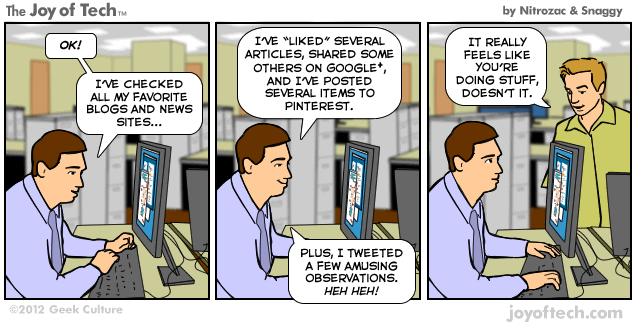
While this comic from All Things D is humorous, it brings up a good point. What are we DOING really, when we use social media in our professional lives? And if we are truly doing something, how do we prove that to our co-workers and superiors?
When we check our favorite blogs and news sites, we are not just glossing over news for our own entertainment; knowledge of global events, trends and industry-specific news is paramount to the success of a public relations team. In order to successfully tell our organizations' stories, we must know what is going on outside of our organizational cocoon. What is the media (both bloggers and traditional media) talking about? And by direct association, what are our publics talking about? In order to partake in the conversation, we need to listen first, and speak second.
Once we have an idea of the conversation taking place online and in the real world, it is time for us (and our organizations) to take part in the conversation. This brings us to the second panel of the cartoon. Note that it is not simply about 'speaking' in the traditional sense; while posting to Google+ and Pinterest is important to provide relevant content to our publics, we must also engage with them. "Liking" things on Facebook (and commenting back) is a great start for our organizations.
Lastly, we must prove that what we have just 'done' is truly relevant and vital to our organizations. As a student of the social media-centric Newhouse school, I see the value of social media management. However, my future bosses and co-workers may not immediately see that value. Just as the ROI of public relations can be difficult to prove, so can the ROI of social media management. We must use social media measurement tools to show that we are influential, relevant and connected among our publics. Only then can we say, yes, we are actually doing something!
For people currently working in social media management positions, or PR in general, what do you think? How do you prove that you are 'doing' something each day?
Thursday, September 27, 2012
CEO Blogs
For this week's PRL614 blog, we were tasked with
reading a CEO blog and evaluating it. Is
it an effective form of public relations for the organization? Is it in sync
with the other communications by the company? Is there more risk or reward in a
CEO blog of this nature? I chose to use the
blog of Dallas Mavericks' owner, Mark Cuban: "Blog
Maverick".
The most recent post was about Wall Street. Others below it touched on issues like CEO
pay, corporations, taxes, even politics.
My first instinct: what are the Mavericks doing allowing their CEO to
comment on such highly-politicized and potentially-alienating topics?! It seems to go against many principles of
public relations to allow a CEO, on a blog associated with the business (the
Mavericks' official website even links to Cuban's blog), to make such bold
statements.
Reading on, I came to realize that Cuban is a
masterful writer and a very smart man.
Topics that most people would butcher, he easily navigates, making
effective arguments based on intellectual thought. While his blog still runs the risk of
alienating publics of the Mavericks who disagree with his ideas, his ideas are
at least articulated in a mature, thoughtful fashion. Inherent in his blog's
name (Blog Maverick) is the
expectation that this blog will be honest, even rogue. Cuban will express his ideas about the world in
an authentic voice, and he won't sugar-coat hot topics.
I would be curious to see analytics on his
blog. How many people read this, and who
are they? Are they reading this as Mark Cuban, CEO and voice of the Dallas
Mavericks? Or are they looking to him for his business expertise?
I believe Mark Cuban has struck an
often-elusive balance in a CEO blog; he is being true to himself in his
postings, and is using this blog to build not only his personal brand but that
of the Dallas Mavericks. Who wouldn't
want a savvy businessman running their sports team? In this unique case, Mark Cuban's opinionated
CEO blog is a successful use of personal blogging by organizational
leadership.
However, most organizations should tread carefully where CEO blogs are concerned. Something tells me that if the CEO of Chick-Fil-A had a personal and political blog, it may not go over as well as Mark Cuban's blog... What do you think?
Sunday, September 23, 2012
Social Media Professionalism
One of the overarching themes of our Newhouse graduate
school education in public relations seems to be the power of social
media. In nearly every course thus far
it has had applications, and in many ways this contributes to our value as
future employees of organizations in need of some social media expertise. Our generation (the Millennials) has grown up
with the internet as an everyday reality of life. We've been taught for years about online
etiquette, what to post, what not to post, and that nothing is ever truly
private online. But an interesting
question has arisen recently, over the idea of shifting every one of our
personal social networks to a professional social network. For most of us, shifting our posts on Twitter
from pictures of our dinner to content relevant to our careers has been a
no-brainer. Google + and LinkedIn are
the same; we see clearly the value of using these social platforms for
professional networking and personal branding.
Facebook, however, presents an interesting dilemma.
While
us graduate students are certainly not advocating posting about binge drinking
or inappropriate behavior, Facebook is our final connection to our personal
lives. We post about our interests, our friends, our fun adventures in Syracuse
and Central New York. We connect with
family and friends who live across the U.S., or even across the globe. We are so busy building our professional
lives here at Newhouse, that Facebook often seems the only communications
platform upon which we can be ourselves.
Must
Facebook too be a platform for solely 'professional' posts? I'd like to think
not. Our personal brand that we work so
hard to build is just that ̶ our personal
brand. Posting about going to the
Syracuse football game, going apple-picking, or on wine-tasting trips in the
Finger Lakes is part of that personal brand.
We are students, and we are serious about our professional ambitions,
but we are also multi-dimensional. We
have personal lives. We have loved ones,
and passions and hobbies. Facebook is
the final frontier, the last untouched platform. We certainly won't be posting anything
inappropriate, but allow us to post about what matters most to us as
people. I'd like to think employers want
to hire people, not simply robots.
Additionally,
I believe the value (both economic and intangible) of Facebook lies with its
promise of personal connections. If all
the users of Facebook were to suddenly transform into
exclusively-professional-posters, I don't think I (or many people) would access
the site as regularly as we do now. The
social media platform would certainly not hold as much value to marketers or
public relations professionals. I once
heard a public relations pro say that social media is all about meeting people
where they are. If Facebook becomes
impersonal, solely a source of artificial, manufactured professional postings,
it no longer is 'where people are'. It
loses its value to marketers, public relations pros and the everyday consumer.
For
these reasons, I will not be transitioning my Facebook to a solely professional
platform. My connections with friends
and family will be most valuable to me in the long run if I keep these
connections personal. One of the most
powerful pieces of advice for social media etiquette is to be authentic, and I
intend to keep my personal brand authentic in every social platform on which I
post.
Friday, September 21, 2012
Free Speech vs. Inflammatory Content
As the
world watches the violence and anti-American protests in many Arab Spring
countries, it is hard not to wonder if this could have been avoided simply by
YouTube invoking prior restraint on the anti-Muslim video created by a
mysterious American. Since the development of the mass media, people have
debated the question of the media's ability to truly elicit actions. Who can be held responsible for the negative
outcome of a message disseminated through the mass (or in recent cases, social)
media? I believe this question has two
components; first, the legal question (can a medium be held legally
accountable?) and second, the ethics question (does a medium have an ethical
duty to act in these cases?).
The Legal Question
In
terms of the legal liability of media for the content they produce or
disseminate, the U.S. Supreme Court has ruled consistently that unless specific
instructions for violence were in the messaging, it is not the media outlet's
fault if violence ensues. (See Brown v.EMA). In the United States, the First
Amendment protects even offensive speech, and even protects the medium through
which such messages are communicated. However, it must be noted that with the rise of social
media, a nearly-international medium, the legal
factor is thrown by the wayside as different governments have different
views of and implications for free speech.
The Ethical Question
In most
cases, although legal action may be pursued by a government trying to restrict
speech or attain information, the question of dissemination of potentially
inflammatory speech often boils down to a question of organizational
ethics. This is not as simple as the
difference between 'right' and 'wrong', however. For example, YouTube willingly removed the
anti-Muslim video from being accessed in certain countries, where it was most
likely to elicit violence.
YouTube/Google believed that their ethical obligation was to try to curb
violence in an already-inflamed situation.
However, Twitter is well-known for its firm stance against infringements
of speech. Earlier this year, the
Pakistani government blocked Twitter after the company refused to remove
certain content that had been disseminated through its channels. Although its reaction was the opposite of
Google's, it believed it was acting ethically by standing for free speech. YouTube takes the more utilitarian view of
free speech ethics, acting in the best interest of the greatest number of
people (by attempting to stop violence), whereas Twitter acts in the deontological view of free speech ethics, seeing a moral duty to uphold the
principles of free speech.
In my
opinion, although I am a supporter of free speech, I believe that social media
outlets like Twitter, Facebook and YouTube have an ethical obligation to curb
the dissemination of inflammatory material.
However, this is a difficult call to make for these organizations. In the United States, groups regularly poke
fun at religious symbols and other 'sacred' images or figures. We would probably not think much of a video
poking fun of a prophet, certainly not enough to begin massacring people and
destroying things. However, in other
countries, where there is not an everyday reality of free (and offensive)
speech, this video elicited an unprecedented reaction of violence and
hate. Social media outlets, being
international entities, must tread carefully when balancing the social and
political value of free speech with the equally-important value of peace and stability.
Tuesday, September 18, 2012
Welcome to Purgatory…I mean…Grad School…
Be sure to check out my bi-weekly blogs for the Ehling Chapter of the Public Relations Student Society of America!
My first piece: http://newhouseprssa.org/2012/09/18/welcome-to-purgatory-i-mean-grad-school/
My first piece: http://newhouseprssa.org/2012/09/18/welcome-to-purgatory-i-mean-grad-school/
Thursday, September 13, 2012
#NBCfail: A for effort
During
the 2012 London Summer Olympics, NBC was eager to stretch its social media
wings, hoping to make use of its Twitter, Facebook, Tumblr, Instagram and
Google+ expertise to engage with viewers of its TV and online coverage. NBC provided a comprehensive guide to its
social media 'coverage' (here)
and had every member of its team contributing to it. From broadcasters to analysts to Ryan Seacrest,
NBC provided viewers with countless lenses through which they could experience
the games.
So how did NBC and its good intentions become #NBCfail?
The
answer: easily. Just as is the case with all public relations or audience
engagement efforts, social media provides the tools for audiences to
revolt. NBC was fighting an uphill battle
by attempting to please all of its diverse viewers in its coverage of the
foreign events. Some viewers wanted
timely delivery of events, while others wanted to be kept in suspense if they
could not feasibly tune in to the live coverage online. Evening news viewers heading to bed early
wanted to know what happened at the Olympics earlier in the day, while
night-owls wanted to wait for the primetime coverage. Workplace multi-taskers wanted to join an
online conversation about the events they watched live online,
while busier workers wanted to wait until the 8-11pm hours to enjoy the games. It was simply impossible for NBC to please
the divergent desires of its audience simultaneously.
Rather
than social media being NBC's legacy for the 2012 games, it became the legacy
of the many people contributing to the #NBCfail conversation. While NBC was certainly very present on a variety
of social media platforms during the games, it was simply unable to control the
wild Twittersphere in its critique of the network's coverage. I give NBC an "A" for effort.
Wednesday, September 5, 2012
"You Always Have Your Stalkers"...and other social media advice
Professor Christy Perry Tuohey presented to our PRL 614 (Advanced Writing for Digital Platforms) class today, bringing with her a wealth of social media tips, tactics and words of caution. Perhaps her most valuable tips were those that were most practical:
Number 4 (don't duplicate information across social media platforms) will also be a challenge for me. It is so easy to simply link one's Facebook, Twitter and other social media accounts, and feel that you have all the bases covered. However, as Professor Tuohey pointed out, one's audience (that of an organization or an individual) does not want to see the same information twice. The modern attention span is barely able to digest information even once, let alone twice or multiple times. For this reason, I will be sure to follow Professor Tuohey's advice as I manage the Life Gets Better Together account (and my own personal account) this upcoming year, and tailor the content I share on each platform to the audience/platform needs.
Overall, a very impressive presentation from Professor Tuohey, the woman behind the @NewhouseSU mask!
- Don't overpost
- Always give links (videos, photos, interactive content)
- Use hashtags (but don't overuse them!)
- Don't duplicate information across social media platforms
- Give credit to friends, colleagues, and content creators
Number 4 (don't duplicate information across social media platforms) will also be a challenge for me. It is so easy to simply link one's Facebook, Twitter and other social media accounts, and feel that you have all the bases covered. However, as Professor Tuohey pointed out, one's audience (that of an organization or an individual) does not want to see the same information twice. The modern attention span is barely able to digest information even once, let alone twice or multiple times. For this reason, I will be sure to follow Professor Tuohey's advice as I manage the Life Gets Better Together account (and my own personal account) this upcoming year, and tailor the content I share on each platform to the audience/platform needs.
Overall, a very impressive presentation from Professor Tuohey, the woman behind the @NewhouseSU mask!
Tweet Chats: The Recitations of the Future?
During
my first tweet chat this week, (#brandchat) I could not help but wonder whether
these pseudo-anonymous, fast-paced conversations could be the 'recitation
sections' of the future. The dreaded 8am
Friday discussions with a teaching assistant or professor could take place
online, in the comfort of one's own bed and pajamas. No need to trek through wind, rain or snow
(in the case of Syracuse) to a small room to sit awkwardly with fifteen other,
equally hung-over undergraduates. Simply
log onto Twitter, and follow the assigned hashtag to participate in and learn
from the online discussion.
In just
one hour, #brandchat covered four great questions about social
media/brands/public relations/marketing techniques and evaluation. Hundreds of people participated, sharing
their ideas and expertise on the questions at hand. I have no doubt I would have been far less
vocal and far more loathe to share my opinions on the topics had I sat in a
room with my renowned and experienced fellow-tweeters. However, hiding behind the mask of my Twitter
handle, I had no problem throwing my ideas out into the abyss, hoping the good
ones would be caught and re-tweeted, and the bad ones forgotten quickly in the
deluge of #brandchat tweets.
If
students were asked to participate in weekly tweet chats rather than weekly
recitation sections, I have no doubt that participation amongst the typically
less-vocal students would increase, and overall student engagement would rise as
well. The ideas being shared could link
quickly and easily to new content. Want
to reference a movie clip from The Great Gatsby or a scholar's analysis of election
trends? Simply add a hyperlink to your tweet, and you and your classmates are
instantly engaged with the content and ideas on a deeper level. Want to bring a guest speaker in to mediate
the discussion about the week's readings? Simply have them join the twitter
chat by using the class hashtag.
In the
world of tweet chats, engagement and knowledge-sharing reaches a new
level. Higher education institutions
would do well to incorporate this new media into their classrooms.
Subscribe to:
Posts (Atom)